
Could a Simple Change to Theatre Headwear Improve Communication and Sustainability?
Could a Simple Change to Theatre Headwear Improve Communication and Sustainability?
HIC is highlighting the work of EcoNinjas, a company developing reusable theatre hats with visible name badges to support staff communication, patient experience and more sustainable operating environments.
Knowing who is in the room matters
Clinical teams need to communicate clearly, direct questions to the right people and work together under pressure. Patients, meanwhile, may find themselves surrounded by people they cannot easily identify.
Yet traditional theatre clothing can make this difficult. Masks, gowns and similar-looking caps mean names and roles are not always immediately visible. Standard ID badges and lanyards can also be hidden beneath clinical clothing.
It is a practical challenge that inspired EcoNinjas to develop an alternative: reusable theatre hats with visible name and role identification.
An innovation shaped by experience
The idea came from Danielle Checketts, co-founder of EcoNinjas, drawing on her experience as a nurse and later as a medical products trainer working in operating theatres.
Having encountered the difficulties of identifying colleagues in theatre settings, Danielle also experienced the issue as a patient undergoing surgery. These different perspectives led her to consider how staff identification could be made clearer for both clinical teams and the people receiving care.
EcoNinjas' Theatre Badge Hats combine reusable scrub hats with name and role badges that help make identification more visible. Interchangeable badges can be updated when responsibilities change, while blank versions can be used for students, visitors and temporary staff.
The intention is to make identification clearer and more consistent, helping staff understand who they are working alongside and giving patients a clearer picture of the team caring for them.
What happened when Somerset put the idea into practice?
There is already an NHS example of the approach in use. At Musgrove Park Hospital, part of Somerset NHS Foundation Trust, a six-week pilot took place in March and April 2025 across three Trauma and Orthopaedics theatres.
The project involved 424 reusable hats and 112 detachable badges. It brought together theatre staff and teams from infection prevention and control, procurement, sustainability and laundry services to explore how the change could operate in practice.
The case study reported a rise in the proportion of staff able to identify colleagues by name and role, from 41% before the pilot to 96% afterwards.
Patient feedback was also positive, with comments describing the reassurance of being able to recognise staff and understand their roles. The case study highlighted the value of visible identification for patients with additional needs, including autistic patients.
Staff feedback described benefits for day-to-day communication and teamwork, particularly when working with unfamiliar colleagues or responding to situations where it is important to direct a question quickly.
These findings offer an encouraging example of how a change to a familiar part of the working environment can support wider conversations about communication and patient experience. They are results from a specific pilot rather than a guarantee of the same outcomes in every theatre department.
Looking beyond single-use products
The Somerset project also explored the environmental and financial case for moving away from disposable theatre caps.
Across the three theatres involved, the case study estimated that using reusable hats could prevent approximately 19,550 disposable caps from being incinerated each year. It calculated an associated annual carbon saving of 1,712.9 kg CO₂e.
Its financial analysis reported a 48% cost saving, with projected savings of £1,289 per year and £3,868.40 over three years.
For NHS organisations working towards their sustainability commitments, this is an area worth considering alongside the operational requirements of any reusable product. The Somerset experience also showed that successful implementation depends on more than choosing an alternative item.
Storage, collection, laundering and redistribution all needed to be addressed. The project worked with laundry services to establish arrangements for cleaning and returning the hats. Staff feedback also informed practical design changes, including refinements to badge design and visibility.
This is useful learning for other organisations. Involving clinical teams and operational colleagues early can help identify barriers and make a new approach easier to incorporate into existing processes.
Taking the learning further
EcoNinjashas continued to develop its work through NHS innovation programmes, including the NHS Propel Accelerator and the NIHR-funded Net Zero Catalyst Programme. The innovation has also attracted wider public attention, including coverage by the BBC.
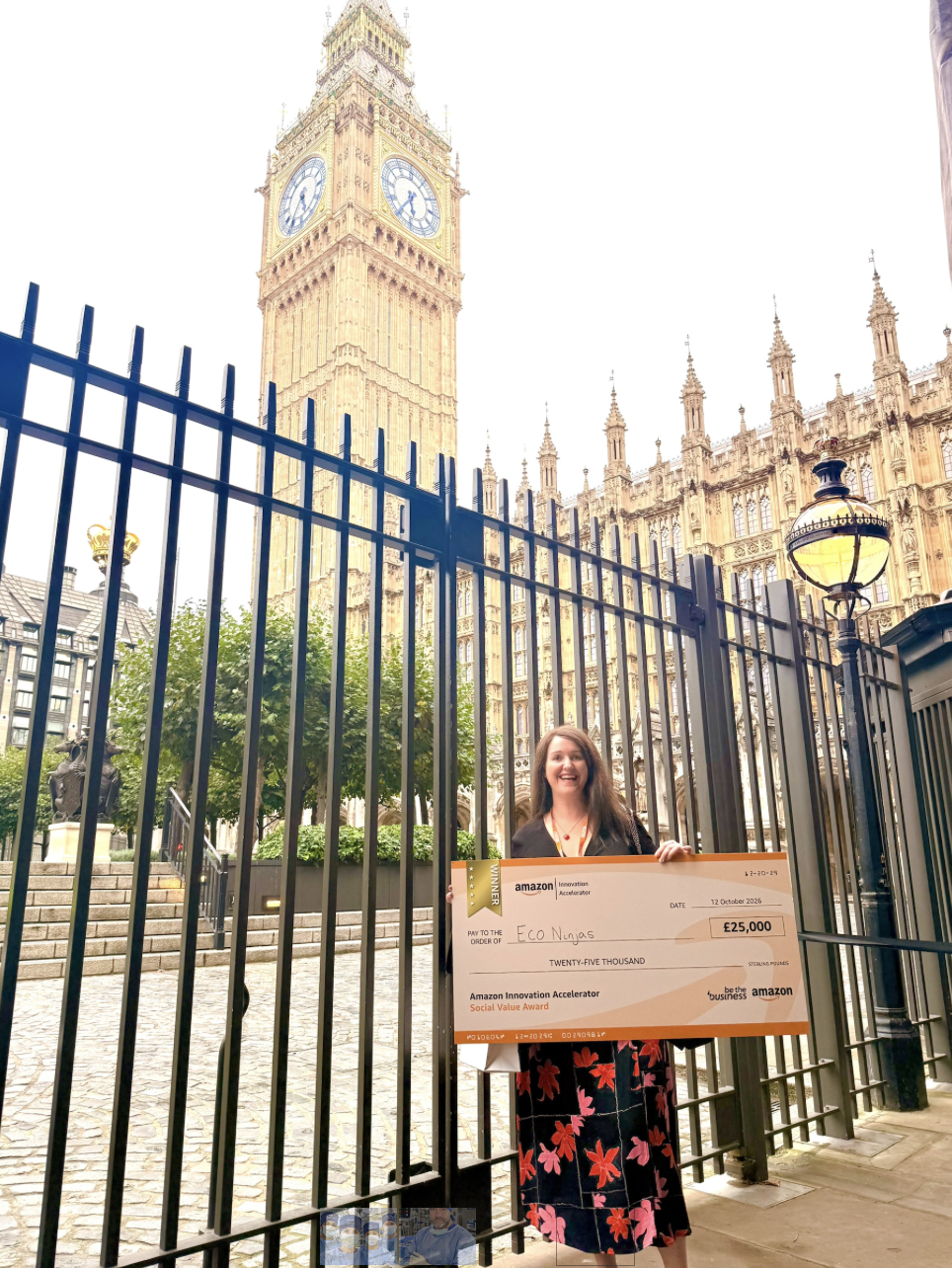
In October 2026, EcoNinjas was recognised at the Houses of Parliament with the Amazon Small Business Accelerator Social Value Award, acknowledging the company's contribution to improving communication, patient experience and sustainability within healthcare.
Building on the success of Theatre Badge Hats, EcoNinj has recently launched an innovative new range of reusable theatre hats featuring fused writable badges. Unlike traditional embroidered hats, the fused badge technology allows names and roles to be written directly onto a durable badge area using white chalk marker pens and updated whenever required. This provides a simple, cost-effective way to maintain clear staff identification while avoiding the waste associated with permanently personalised theatre hats.
The fused badge range also creates opportunities for centralised laundering, supporting current infection prevention and control guidance for reusable healthcare textiles and providing organisations with greater flexibility when introducing reusable theatre headwear.
The Somerset pilot provides a starting point for further evaluation, particularly as NHS organisations consider how improvements to staff experience, patient communication and sustainability can be delivered together.
The company also offers a rental model, intended to give trusts an alternative to purchasing reusable hats upfront and enabling reusable adoption through existing disposable headwear budgets.
Connecting NHS organisations with innovation
The Theatre Badge Hats project is an example of how an idea informed by frontline experience can develop into an innovation with relevance to several NHS priorities.
The Somerset pilot offers encouraging findings alongside practical lessons about implementation. Further collaboration with hospitals could help establish how the approach works in different settings and what benefits can be sustained over time.
At HIC, we want to help bring relevant innovations to the attention of NHS organisations and create opportunities for meaningful collaboration between healthcare providers and industry.
EcoNinjasis looking for five hospitals interested in exploring the Theatre Badge Hats approach and contributing to further evaluation. If your organisation would like to find out more, contact HIC and we can help make an introduction.
Further reading: Somerset NHS Foundation Trust case study | BBC coverage |EcoNinjas.
